It starts innocently enough — a kid playing with Silly Putty, a therapy session with sensory putty, a fidget toy left in a pocket — and suddenly you’re staring at a sticky, gooey blob embedded deep into your favorite shirt. If you’re searching for how to get putty out of clothes, you’ve come to the right place.
The good news? Putty stains are almost always removable. The key is knowing which cleaning agent works for your fabric type and acting before the stain fully sets. This guide walks you through seven tried-and-tested methods, a clear step-by-step process, fabric-specific advice, and the critical mistakes to avoid.
Why Is Putty So Hard to Remove from Fabric?
Understanding the problem is the first step to solving it. Whether it’s Silly Putty, therapy putty, kinetic sand putty, or thinking putty, most varieties share two properties that make fabric removal tricky:
- Silicone oil base — The oil component creates a greasy stain that behaves just like grease on fabric, binding to fibers and resisting water alone.
- Sticky, stretchy consistency — The polymer chains in putty physically grip individual fabric fibers, stretching deeper into the weave the more you rub.
This is why the first rule of putty removal is: never rub or scrub the stain initially. Rubbing pushes putty deeper into the fabric and spreads the oily residue further.
Before You Start: Essential Preparation
Take these steps before applying any cleaning solution:
- Act quickly. Fresh putty is always easier to remove than dried or set putty. The longer it sits, the deeper the silicone oil penetrates the fibers.
- Scrape off excess putty first. Use a butter knife, dull-edged spoon, or even the edge of a credit card to gently lift as much putty off the surface as possible. Work from the outside of the stain inward.
- Check the care label. Before applying any chemical solution, verify what your fabric can tolerate.
- Test your chosen solution on a hidden seam or inner hem before applying to the visible stain. Some solvents can affect color or delicate fibers.
- Never put the garment in the dryer until you’re certain the putty and its oily residue are completely gone. Heat permanently sets stains.
7 Methods to Get Putty Out of Clothes
Method 1: Freeze It (Best First Step for Any Putty)
Freezing is almost always the ideal starting point — especially for large amounts of putty or fresh stains. Cold temperatures make the putty brittle, causing it to contract away from fabric fibers and become far easier to scrape off cleanly.
How to do it:
- Place the garment in a sealed plastic zip-lock bag (to protect other items in the freezer).
- Freeze for 1–2 hours, or until the putty feels completely hard to the touch.
- Remove from the freezer and immediately use a dull knife, butter knife, or stiff brush to chip and peel the frozen putty off the fabric.
- Work quickly — putty warms up and re-softens fast at room temperature.
- Treat any remaining oily residue with one of the methods below.
💡 Tip: For thick fabric like denim or canvas, you can also press an ice pack or a bag of ice directly against the putty for 15–20 minutes as an alternative to freezing the whole garment.
Method 2: Hand Sanitizer (Easiest and Most Effective)
This is the method that surprises most people — but it genuinely works. Alcohol-based hand sanitizer (the clear gel variety) contains roughly 60–70% ethanol, which dissolves the silicone polymer in putty without damaging most fabric types. It’s a particularly good choice for parents dealing with Silly Putty on children’s clothing.
How to do it:
- After scraping off excess putty, apply a generous amount of clear hand sanitizer directly over the stain.
- Gently work it into the putty with your fingers or a soft-bristled toothbrush.
- Let it sit for 1–2 minutes — don’t let it sit too long, as aloe vera and fragrance in some sanitizers can leave their own residue.
- Scrape away the dissolved putty with a dull knife or your fingernail.
- Repeat if necessary, then wash the garment as normal.
- Check the stain before drying — if an oily mark remains, treat it with dish soap (see Method 6) before washing again.
⚠️ Always do a patch test first, as some sanitizer formulas can affect certain dyes. Use clear, unfragranced gel when possible.
Method 3: WD-40 (Best for Stubborn or Dried Putty)
WD-40 is a petroleum-based lubricant that loosens the grip putty has on fabric fibers. It’s especially effective when putty has dried or been sitting for more than a few hours — and it’s the go-to recommendation from Crayola (the company that owns Silly Putty) for fabric stain removal.
How to do it:
- Spray WD-40 directly onto the putty stain and let it penetrate for 3–5 minutes.
- Use a dull-edged knife or metal spoon to scrape off loosened putty.
- Re-spray the area and wipe away residue with a clean cotton ball or cloth.
- If a faint stain remains, apply a small amount of rubbing alcohol with a cotton swab and blot gently.
- Follow up immediately with dish soap and warm water to remove WD-40’s oily residue.
- Machine wash on the recommended setting.
⚠️ WD-40 leaves an oily residue of its own — it’s critical to follow up with dish soap before machine washing, or you’ll trade one stain for another.
Method 4: Rubbing Alcohol / Isopropyl Alcohol (Best for Natural Fibers)
Rubbing alcohol (70% isopropyl) is a powerful solvent against the silicone oil in putty and works beautifully on natural fabrics like cotton, linen, and denim. It’s also a good secondary treatment after freezing and scraping.
How to do it:
- Dampen a clean white cloth or cotton ball with rubbing alcohol.
- Blot — don’t rub — the stain, working from the outer edges toward the center.
- As the putty dissolves, use a dull tool to scrape off loosened material.
- Keep blotting with fresh alcohol-soaked cotton until no putty transfers to the cloth.
- Rinse with cold water, then wash normally.
⚠️ Rubbing alcohol can degrade certain synthetic fabrics over time. For polyester, nylon, or spandex blends, WD-40 or hand sanitizer is a safer choice.
Method 5: Goo Gone or Goof Off (Best Commercial Product Option)
For particularly stubborn or old putty stains, commercial adhesive removers like Goo Gone or Goof Off are purpose-built for exactly this kind of job. They break down sticky, polymer-based substances and are safe on most colorfast fabrics.
How to do it:
- Apply Goo Gone directly to the stain and let it sit for 5–10 minutes.
- Work it into the stain with a soft cloth or old toothbrush.
- Scrape away dissolved putty with a dull-edged tool.
- Wash immediately with hot water and dish soap or laundry detergent to remove all solvent residue.
Method 6: Dish Soap (Essential for Removing the Oily Residue)
Even after the solid putty has been removed, a greasy shadow stain often lingers. This is the silicone oil component. Dish soap — specifically the kind formulated to cut through grease — is the best tool for this final stage.
How to do it:
- Apply a few drops of liquid dish soap (Dawn or similar) directly to the oily residue.
- Work it in gently with your fingers or a soft cloth.
- Let it sit for 5 minutes.
- Rinse with warm water.
- Machine wash as normal.
This step is essential after using WD-40, Goo Gone, or any oil-based solvent. Don’t skip it.
Method 7: Putty-on-Putty Technique (Best for Small Spots)
Here’s a clever low-tech trick recommended by occupational therapists who deal with therapy putty regularly: use a fresh wad of putty to lift putty off fabric.
How to do it:
- Take a clean, unused piece of putty (or a fresh sticky adhesive like poster tack).
- Press it firmly and repeatedly onto the stained area.
- The fresh putty bonds to the embedded putty, lifting it away from the fabric fibers a little at a time.
- Keep pressing with a clean section of putty until no more transfers.
- Spot clean any residue with rubbing alcohol or dish soap.
This works best on small, surface-level spots and is ideal for situations where you have no other cleaning products on hand.
Also Read this: How to Get Mold Stains Out of Clothes?
Method Comparison Table
| Method | Best For | Fabric Safety | Removes Oily Residue? | Effort Level |
| Freezing | All types, fresh putty | ✅ All fabrics | ❌ No (needs follow-up) | Low |
| Hand Sanitizer | Most fabrics, quick fix | ✅ Most fabrics | Partially | Low |
| WD-40 | Dried/stubborn putty | ✅ Most fabrics | ❌ No (use dish soap after) | Medium |
| Rubbing Alcohol | Natural fiber fabrics | ⚠️ Not for synthetics | Partially | Medium |
| Goo Gone/Goof Off | Old/set-in stains | ✅ Colorfast fabrics | ✅ Yes | Medium |
| Dish Soap | Oily residue stage | ✅ All fabrics | ✅ Yes | Low |
| Putty-on-Putty | Small surface spots | ✅ All fabrics | ❌ No | Low |
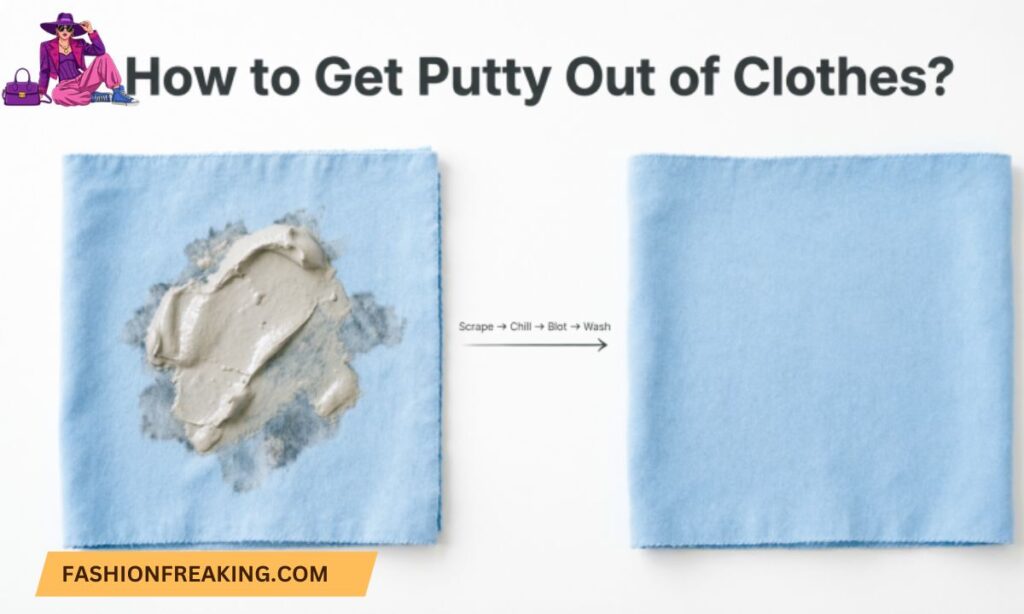
Step-by-Step: The Complete Putty Removal Process
For best results from start to finish, follow this sequence:
- Scrape off excess putty with a dull knife — work from the outside in.
- Freeze the garment for 1–2 hours, then chip off remaining frozen putty.
- Apply your chosen solvent (hand sanitizer, rubbing alcohol, or WD-40) to break down what’s left.
- Blot and scrape until no more putty lifts off.
- Treat the oily residue with liquid dish soap and let it dwell for 5 minutes.
- Inspect before washing — run the stained area under warm water to check if the stain is clear.
- Machine wash on the hottest setting safe for the fabric.
- Air dry and check again before putting in the dryer. Heat permanently sets any remaining stain.
Common Mistakes to Avoid
Avoiding these errors will save your garment and your sanity:
- Rubbing the stain — This embeds putty deeper into fabric fibers. Always blot and scrape.
- Using heat too early — Never use a hot dryer, iron, or hot water on a putty stain before it’s fully removed. Heat locks the silicone oil into the fabric permanently.
- Skipping the patch test — Always test any solvent on a hidden area first to avoid color damage or fiber degradation.
- Letting WD-40 sit too long — WD-40 loosens putty but leaves its own oily mark if not followed up immediately with dish soap.
- Forgetting to treat the oil residue — Even when the visible putty is gone, the oily shadow remains. Don’t skip the dish soap step.
Putty Removal by Fabric Type
| Fabric Type | Recommended Method | What to Avoid |
| Cotton / Denim | Freezing + rubbing alcohol | Heat |
| Polyester / Nylon | Freezing + WD-40 + dish soap | Rubbing alcohol (degrades synthetics) |
| Delicate (silk, wool) | Hand sanitizer (patch test first) | WD-40, harsh solvents |
| Upholstery / Couch | WD-40 + dish soap | Soaking |
| Carpet | WD-40 + dish soap | Bleach |
Conclusion
Getting putty out of clothes is absolutely achievable — even when the stain has dried or been sitting for days. The golden rules are: don’t rub, don’t use heat, always treat the oily residue last, and check before drying. Start with freezing for any significant amount of putty, follow with hand sanitizer or rubbing alcohol for most fabric types, and finish with dish soap to eliminate the greasy shadow stain.
Act fast, follow the steps in order, and your garment will come out of the wash looking like it never had an encounter with putty at all.
Frequently Asked Questions
Does rubbing alcohol remove putty from clothes?
Yes — it’s highly effective on natural fabrics like cotton and denim, but avoid it on synthetic blends as it can degrade the fibers over time.
Can you get dried putty out of clothes?
Absolutely. Freeze the garment first to make dried putty brittle, then follow with WD-40 or Goo Gone to dissolve what remains.
What removes Silly Putty from clothes fast?
Hand sanitizer is the fastest method — apply, work in gently, and scrape off. It dissolves Silly Putty’s silicone polymer in just a minute or two.
Will putty stain clothes permanently?
Not if you treat it promptly and avoid using heat before the stain is gone. Heat is what turns a temporary stain into a permanent one.
Is WD-40 safe to use on clothes?
Yes, but always follow up with dish soap to remove WD-40’s oily residue before washing. Without that step, you’ll end up with a grease stain instead.
How do you get therapy putty out of clothes?
The same methods apply — freeze first, then use rubbing alcohol or hand sanitizer. Therapy putty contains similar silicone polymer compounds as Silly Putty.
Can I put clothes with putty in the washing machine first?
Don’t machine wash until you’ve manually removed the putty and its oily residue. Washing without pre-treating can spread the stain and permanently set it in the drum’s heat.
What removes the greasy stain left after putty?
Liquid dish soap (like Dawn) is the most effective product for breaking down the oily silicone residue left after putty has been removed.

Shoaib is the creative mind behind FashionFreaking.com, sharing trendy insights on shoes, jewelry, clothes, and modern fashion to inspire confidence, style, and everyday elegance for fashion lovers worldwide.